
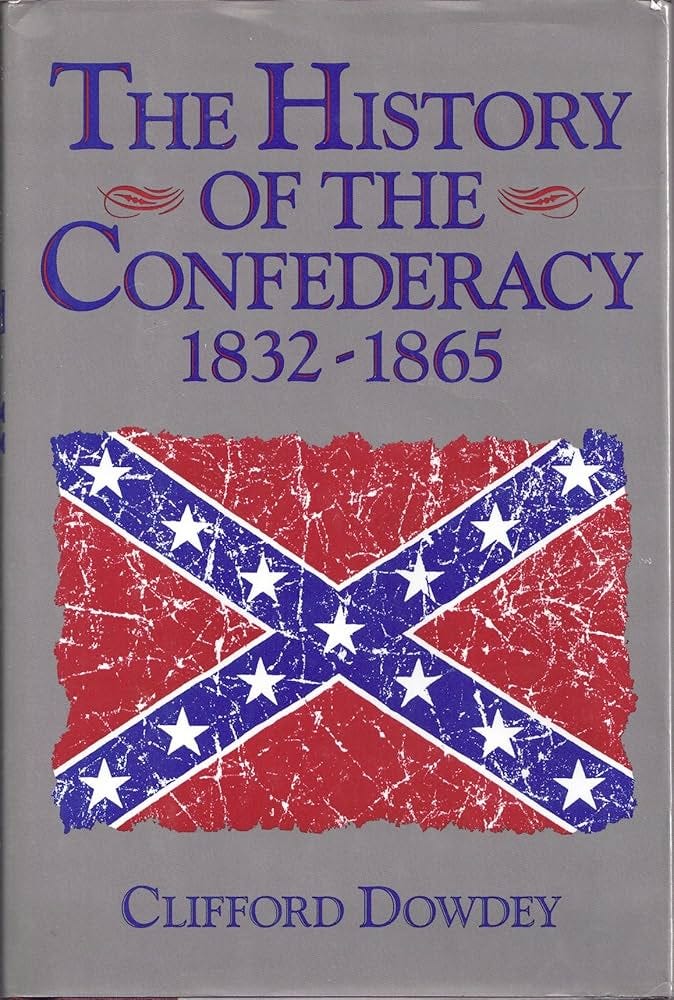
When I was in college, my friends threw a party for me. They were very sweet, and they gave me some presents. They knew I liked to read, so they gave me some books that they knew would mean a lot to me. One was a book of quotes by Robert E. Lee, and the other is pictured above: The History of the Confederacy. These dear friends wanted to give me something that they knew I would like: these tales from the Old South.
Being a child with some real pain in my life, I was always looking for a place to belong. I wanted a people to claim as my own and who would claim me. I found that belonging, or identity, in a lot of ways that I still do: my United Methodist Church, my hometown (Bogue Chitto), and my love of sports. But one of the places I found the greatest identity was in the mythology of the Old South. Those ghosts were always kicking around my soul.
I thrilled to read about Lee and the Shenandoah Campaign. I read about how Vicksburg suffered while Natchez surrendered. I wonder what would have happened if Pickett had pulled it off. I thought about what I understood to be nobility of the Lost Cause and that War of Northern Aggression. I thought about how Reconstruction set the South back in general and Mississippi back specifically. I saw cause, and I saw identity in that history. As a poor boy from the South, I found victory and nobility in their courage. In Stonewall Jackson’s faith. In a Mississippian being the President of the Confederacy. I used to drive in my car listening to the soundtrack of Ken Burns’ Civil War documentary. (Also note, I was a tremendous nerd lol).
I believe I may have even had ancestors who fought for the South. It was who I was, or who I wanted to be.
But, it wasn’t all who I was. We are, as people, inconsistent. We often hold two things together that cannot be so. I had this deep love and reverence for the Confederacy. These histories defined the reading of my early childhood and who I was into college.
At the same time, I was also among some of the first generations of students in Southwest Mississippi to attend fully integrated schools. I started school in the early 80s, and integration was something everyone was getting used to. In some ways, we did well. Not so well in other ways. But I always had African-American friends, classmates, teammates, and teachers, and took great pride in that. When I was named STAR Student, the STAR teacher I chose to honor as the teacher who influenced me the most was African-American. I deeply respected this man and do to this very day.
So, there were two things in opposition, and they were in some ways fighting over what would truly define my life.
Oh, and one more thing. My biological mother, my Mama Sarah, was born in Ecuador. Her father was from there. She was half Ecuadorian, making me a quarter Ecuadorian. That fact of genetic heritage can raise some real conflict within the soul of someone with a previously mentioned love of the Deep South.
In my early twenties, not long after receiving this book, I began my ministry. I began to think more deeply about what I believed. Who was I? What defined me? What did I want to be about? What did I want my ministry to be about? What was going to be the cause I laid down my life for? I found that cause in Jesus’ teachings. I have liked the way that John Wesley laid it out, in what I have heard called the “Alls.”
· All are made in the image of God.
· All are sinful and in need of salvation.
· All can be saved.
· All can be saved to the uttermost.
In other words. God loves everyone. The folks I like, the folks I don’t. The folks who agree with me on theology, on politics, on social issues, on all the stuff, as well as the folks who don’t agree with me on any of it. God loves them so much that He gave Jesus for them. He sincerely, deeply, honestly loves them.
And if He loves them. I have to love them.
Which means I have to value them. Care for them. Listen to them. Hear them. Advocate for them. Be there for them. No matter race, creed, or any human division.
If I have to love people, I have to listen to people.
My love for my African-American friends and hearing their pain regarding past and present racism was more important than any false identity I had or narrative I had internalized. There came a point where I could no longer look my African-American friends in the face and deeply love them while holding onto my nostalgia for the Confederacy. I had to let that go. To fully love them, I had to let that go. I could no longer place any nostalgia or sectional identity above my truest identity, a baptized child and servant of Jesus Christ, called to love everyone, regardless of race, creed, or anything else. And to love, I had to listen. And value. And lay down my life.
Dr. James Merrit, former President of the Southern Baptist Convention, put it quite well in this speech. People matter more than anything.
As Oliver Wendell Holmes, Jr. famously said:
Your right to swing your fist ends where my nose begins.
I want to value others above myself. I want to make sure that in my freedom to swing my fist, I don’t pop someone in the nose. As a follower of Christ, their nose matters more than my fist. As Paul says in Philippians 2: 2-3:
make my joy complete: be of the same mind, having the same love, being in full accord and of one mind. Do nothing from selfish ambition or empty conceit, but in humility regard others as better than yourselves. Let each of you look not to your own interests but to the interests of others.
So, today, as we think through our identity, what is our primary identity? It took me many years to fully understand that my truest identity is in Jesus, and that my trust identity is in who I am in Jesus, and who you are in Jesus. And I will love you more than I love anything, except for Jesus.
As CS Lewis said in The Weight of Glory:
Next to the Blessed Sacrament itself, your neighbor is the holiest object presented to your senses.
To my African-American friends, I am sorry that it took me into my twenties to really listen to your voice. I am sorry that I spent too much time focusing on my need for identity and a false mythology and narrative, rather than on your need for existence and equality. Since I saw this error, I have sought to listen, to learn, and to grow.
I’m not telling you what to think or believe. I’m just telling you what I have learned, and what I wish I had learned earlier. We all live this life as best we can. But I know this: when I draw my last breath, I hope I can say that I did all that I could to love folks, accept folks, and let them know they were loved perfectly by an amazing God, and imperfectly, but as good as possible, by a fallen man like me.
Love each other, y’all, more than anything else.